
Why We Need to Unstack: The Science of Metabolic Health
“Health is not determined by one meal. It is determined by the thousands of metabolic conversations your body has with the food you eat every day.”

When I first became a physical therapist, I believed movement was the missing piece to better health.
After treating thousands of patients over the past three decades, I discovered something much bigger.
Some patients healed remarkably well.
Others, despite faithfully performing every exercise I prescribed, continued to struggle with chronic pain, fatigue, inflammation, obesity, poor sleep, depression, anxiety, and slow recovery.
I began asking myself one question.
Why do two people with the exact same injury heal so differently?
The answer, I eventually realized, had less to do with the injured body part than with the internal environment in which healing was taking place.
That environment is called metabolic health.
The more I studied nutrition, endocrinology, inflammation, neuroscience, psychology, and lifestyle medicine, the more one truth became obvious:
Metabolic dysfunction quietly drives many of the chronic diseases that dominate modern medicine.
Yet very few people understand what metabolic health actually is.
That changes now.
The purpose of this book is not to convince you to follow another fad diet.
It is to teach you how your body actually works.
Once you understand that, healthy eating becomes much simpler.
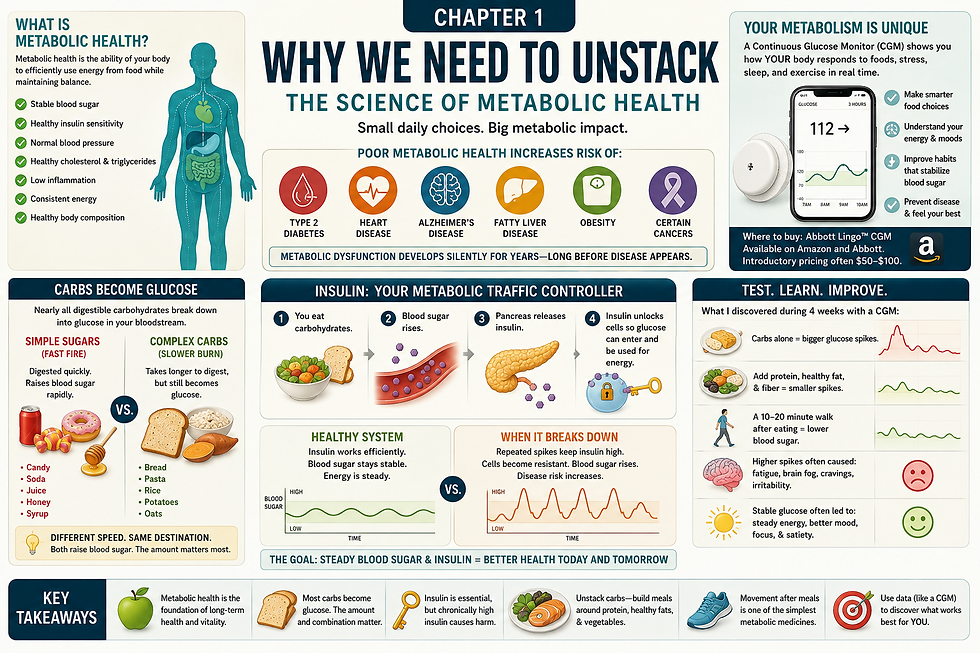
What Is Metabolic Health?
Metabolism is every chemical reaction occurring inside your body that keeps you alive.
It converts food into energy, repairs tissues, regulates hormones, fuels your brain, supports your immune system, builds muscle, stores fat, and maintains life itself.
A metabolically healthy person generally has:
• Stable blood sugar
• Healthy insulin sensitivity
• Normal blood pressure
• Healthy triglycerides
• High HDL cholesterol
• Low levels of chronic inflammation
• Good energy throughout the day
• Minimal visceral (abdominal) fat
Unfortunately, this state has become surprisingly uncommon.
A landmark analysis published in Metabolic Syndrome and Related Disorders estimated that only about 12% of American adults meet the criteria for optimal metabolic health (O’Hearn et al., 2022). In other words, nearly nine out of ten adults already have measurable metabolic abnormalities that increase the risk of chronic disease—even if they have never been diagnosed with diabetes.
Most people don’t become sick overnight.
Metabolic disease develops silently over years or even decades.
Long before blood sugar becomes high enough for a diabetes diagnosis, insulin levels have often been elevated for years while inflammation slowly damages blood vessels, nerves, organs, and joints.
Why Metabolic Health Matters
Poor metabolic health affects far more than body weight.
Today it is recognized as a major contributor to:
• Type 2 diabetes
• Prediabetes
• Obesity
• Coronary artery disease
• Stroke
• High blood pressure
• Fatty liver disease
• Polycystic ovarian syndrome (PCOS)
• Chronic kidney disease
• Alzheimer’s disease
• Certain cancers
• Osteoarthritis
• Chronic pain
• Depression
• Anxiety
• Cognitive decline
• Reduced immune function
Researchers increasingly recognize insulin resistance and chronic inflammation as common biological pathways linking many of these conditions (American Diabetes Association, 2026; Nature Reviews Endocrinology, 2024).
This is why improving metabolic health doesn’t simply reduce the risk of diabetes.
It improves your entire physiology.
The Body Runs on Glucose
Your brain, muscles, and organs all require energy.
One of the body’s primary fuels is glucose, a simple sugar circulating in the bloodstream.
Where does glucose come from?
Almost everything you eat containing digestible carbohydrates.
Many people think only candy and desserts become sugar.
Not true.
Your digestive system breaks down nearly every carbohydrate into glucose.
This includes:
• Bread
• Pasta
• Rice
• Potatoes
• Tortillas
• Crackers
• Pretzels
• Oatmeal
• Cereal
• Bagels
• Pancakes
• Fruit juice
The difference isn’t whether they become glucose.
The difference is how quickly.
Simple Sugars vs. Complex Carbohydrates
Imagine starting a campfire.
Simple sugars are newspaper.
They ignite almost immediately.
Examples include:
• Candy
• Soda
• Honey
• Syrup
• Sweet tea
• Fruit juice
Complex carbohydrates are logs.
They burn more slowly because digestion takes longer.
Examples include:
• Bread
• Brown rice
• Oats
• Beans
• Sweet potatoes
• Whole grains
However—and this is one of the most important concepts in this book—
Both eventually become glucose.
The body doesn’t care whether glucose originated from a glazed doughnut or several slices of bread.
It still has to manage it.
Some refined starches raise blood sugar almost as rapidly as table sugar because digestion occurs so quickly.
This is measured by the glycemic index and glycemic load, concepts we’ll return to later in the book.
Meet Insulin: Your Metabolic Traffic Controller
Every time glucose enters your bloodstream, your pancreas releases a hormone called insulin.
Think of insulin as a traffic officer directing glucose where it needs to go.
It opens the doors of your cells so glucose can enter and be used for energy.
Without insulin, glucose remains trapped in the bloodstream.
This system is beautifully designed.
Problems arise when glucose levels rise repeatedly throughout the day.
Each spike requires another release of insulin.
Years of repeatedly elevated insulin cause many cells to become less responsive.
This condition is called insulin resistance.
The pancreas responds by producing even more insulin.
Eventually it cannot keep up.
Blood sugar begins to rise.
Prediabetes develops.
Later comes Type 2 diabetes.
But the disease process usually started many years earlier.
Research Spotlight
Large prospective studies now suggest that insulin resistance can precede the diagnosis of Type 2 diabetes by 10 to 20 years, providing a long window during which lifestyle changes can dramatically reduce disease risk.
Why We Need to Control Carbohydrates
Notice I didn’t say eliminate carbohydrates.
Carbohydrates are not evil.
Many are extremely nutritious.
The problem is stacking too many glucose-producing foods together in one meal.
Imagine eating:
Orange juice
Toast
Hash browns
Pancakes
Syrup
Fruit
Although these appear to be different foods, metabolically they represent one enormous glucose load.
The pancreas must respond with a large insulin release.
Compare that with:
Eggs
Avocado
Greek yogurt
Berries
The second meal generally produces a much smaller glucose response while providing greater satiety.
This simple principle is what I call Unstacking.
Instead of stacking multiple carbohydrates together, we intentionally limit each meal to one primary carbohydrate source while building the meal around protein, vegetables, healthy fats, and fiber.
Food Is Information
Food is far more than calories.
Food is information.
Every bite tells your hormones what to do.
Increase insulin.
Decrease insulin.
Store fat.
Burn fat.
Increase inflammation.
Reduce inflammation.
Become hungry.
Stay full.
Become sleepy.
Stay energized.
Food communicates with nearly every cell in your body.
My Four-Week Experiment with a Continuous Glucose Monitor
One of the most educational experiences I’ve ever had was wearing a continuous glucose monitor (CGM).
A CGM is a small sensor worn on the back of the upper arm that measures glucose continuously—day and night.
Instead of checking blood sugar once with a finger stick, it records hundreds of readings every day.
I decided to turn myself into an experiment.
For the first two weeks, I ate many of the foods I normally enjoyed and watched what happened.
Then I wore another CGM for two additional weeks.
This time I tested foods I believed were healthy.
Some shocked me.
Foods I thought would barely affect blood sugar created huge spikes.
Other foods I expected to be terrible hardly changed my glucose at all.
Even more surprising was discovering that how I ate mattered just as much as what I ate.
When I ate bread alone, my glucose climbed rapidly.
When I ate the same bread with chicken, avocado, and vegetables, the rise was much smaller.
When I took a brisk walk after eating, my glucose often came back down much faster.
The experience completely changed the way I think about food.
What I Tested
During those four weeks I experimented with nearly everything I was curious about.
Different breads.
Rice.
Potatoes.
Pizza.
Ice cream.
Fruit.
Granola.
Protein shakes.
Restaurant meals.
Coffee drinks.
Fast food.
I also tested:
• Carbohydrates eaten alone
• Carbohydrates combined with protein
• Carbohydrates combined with healthy fats
• Carbohydrates combined with fiber-rich vegetables
• Eating dessert after protein versus before dinner
• Walking after meals
• Strength training after meals
• Poor sleep
• Stressful workdays
Everything changed my glucose.
Some things changed it dramatically.
Others hardly changed it at all.
It taught me that nutrition is incredibly personal.
Research Spotlight
Large studies using continuous glucose monitors have shown that two healthy people eating the exact same meal can have dramatically different glucose responses. Genetics, gut bacteria, sleep quality, stress, exercise, previous meals, age, and body composition all influence how your body processes carbohydrates.
This is one reason the Unstacking Diet emphasizes learning your body’s responses instead of assuming every person reacts identically.
Connecting Blood Sugar to Energy and Mood
Perhaps the biggest surprise wasn’t the numbers.
It was how closely they matched how I felt.
Large glucose spikes were often followed by:
• Brain fog
• Afternoon fatigue
• Sugar cravings
• Irritability
• Difficulty concentrating
• Hunger only a few hours later
Meals that kept glucose relatively stable left me feeling:
• Calm
• Focused
• Productive
• Mentally clear
• Full much longer
Emerging research suggests that frequent glucose fluctuations may influence mood, cognitive performance, and energy levels, although the strength of these relationships varies between individuals. Many people find that paying attention to both their glucose patterns and how they feel helps them identify eating habits that support steadier energy throughout the day.
Should You Wear a Continuous Glucose Monitor?
I believe nearly everyone interested in improving metabolic health could benefit from wearing a CGM for two to four weeks as a learning exercise.
Not forever.
Just long enough to understand your own metabolism.
You’ll quickly discover:
• Which breakfasts keep you full
• Which restaurant meals spike your glucose
• Whether oatmeal works well for you
• Whether sourdough affects you differently than white bread
• How stress changes your glucose
• How poor sleep changes your metabolism
• How exercise lowers blood sugar
• How combining carbohydrates with protein, healthy fats, and fiber affects your response
One of the most accessible options for people without diabetes in the United States is the Abbott Lingo™ CGM. Depending on promotions and the retailer, introductory pricing is often in the $50–$100 range for a sensor, and it is available directly from Abbott as well as through major online retailers, including Amazon. Prices change frequently, so compare current offers before purchasing.
This Is Only the Beginning
The Unstacking Diet is not about fear.
It is not about perfection.
It is not about eliminating every carbohydrate.
It is about understanding your biology.
When you understand why your body responds the way it does, healthy eating stops being a battle of willpower.
Instead, it becomes a series of informed choices.
That knowledge gives you something no fad diet ever can:
Freedom.
Chapter Summary
Metabolic health influences nearly every organ system and plays a central role in preventing chronic disease.
Most digestible carbohydrates are broken down into glucose, regardless of whether they taste sweet.
Insulin helps move glucose from the bloodstream into cells, but chronically elevated insulin can lead to insulin resistance over time.
“Unstacking” means avoiding multiple high-carbohydrate foods in the same meal and instead emphasizing protein, healthy fats, vegetables, and a single primary carbohydrate source.
A continuous glucose monitor can be a powerful educational tool, helping you learn how different foods, meal combinations, sleep, stress, and exercise affect your own body.
Lasting change comes from understanding your metabolism—not from chasing the latest diet trend.
Selected References
American Diabetes Association. (2026). Standards of Care in Diabetes—2026. Diabetes Care, 49(Suppl. 1).
O’Hearn, M., et al. (2022). Trends in metabolic health among U.S. adults. Metabolic Syndrome and Related Disorders.
Evert, A. B., et al. (2024). Nutrition therapy for adults with diabetes or prediabetes. Diabetes Care.
Lazić, A., & Trajković, N. (2026). Effects of acute postprandial exercise on continuous glucose monitoring outcomes: A systematic review and meta-analysis. Reviews in Endocrine and Metabolic Disorders.
Peng, M., et al. (2026). Continuous glucose monitoring and lifestyle behavior change: A systematic review and meta-analysis. International Journal of Behavioral Nutrition and Physical Activity.
Ludwig, D. S., & Ebbeling, C. B. (2022–2025). Carbohydrate quality, glycemic response, and metabolic health. American Journal of Clinical Nutrition and related reviews.
Taylor, R. (2021–2025). Research on insulin resistance and remission of type 2 diabetes.
Nature Reviews Endocrinology. (2024). Reviews on insulin resistance, obesity, and metabolic disease.



Comments