
The Familiarity Trap: Why We Return to Lives We Say We Want to Change
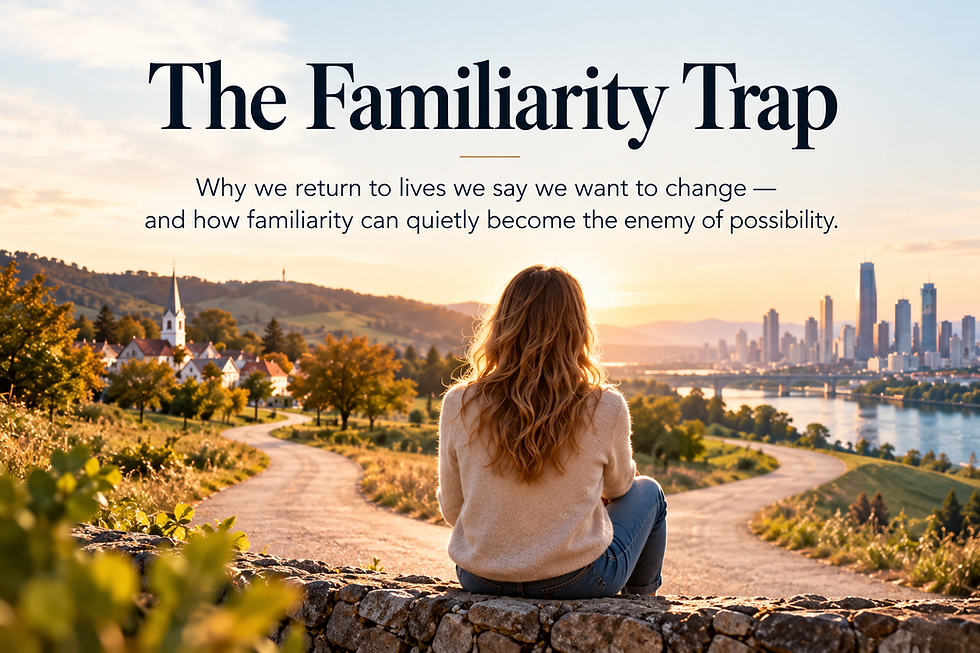
The psychology of choosing what we know over what we want—and how familiarity can quietly become the enemy of possibility.
What if the greatest obstacle to creating the life we want isn’t a lack of opportunity, but our attachment to the life we already know?
I have two friends who live in a small town. Both are single, both would like meaningful romantic relationships, and both regularly express frustration with the limited opportunities to meet compatible men in their community.
They recognize that their environment may not offer what they are looking for. They have traveled, spent extended periods elsewhere, and experienced places with greater social possibilities.
Yet something interesting happens.
They miss their little town.
And eventually, they return.
Another friend shared a similar story about her nephew, who was living in Arkansas. She offered him what many people would consider a remarkable opportunity: a wonderful job, a place to live, and the chance to build a new life in California.
He accepted. He moved. He experienced the opportunity.
And then he returned to Arkansas.
Not necessarily because California was objectively worse, or because the opportunity wasn’t real, but because he missed home.
These stories raise a fascinating psychological question:
Are we genuinely choosing the lives we want, or are we unconsciously choosing the environments that feel familiar—even when those environments may limit the futures we say we desire?
Recent psychological research suggests that familiarity, habit, identity, and belonging all influence how people evaluate change. But understanding those influences requires us to distinguish between genuine belonging and the comfort of repetition.
1. The Mere-Exposure Effect: Why Familiarity Feels Good
The mere-exposure effect was first identified in earlier psychological research, but more recent studies continue to show that repeated exposure can shape preferences and evaluations.
When we encounter something repeatedly, it often becomes easier to process. That ease can be experienced as comfort, liking, or trust, even when we have not consciously decided that the familiar option is better.
Consider what this means for the environments in which we live.
The familiar grocery store. The same restaurants. The streets we have driven for decades. The people whose personalities we understand. The predictable rhythms of everyday life.
These experiences become part of our psychological landscape.
We don’t have to think very hard to navigate them.
A new environment, by contrast, requires effort. We must learn new routines, develop relationships, navigate unfamiliar social expectations, and tolerate uncertainty.
Recent research on processing fluency suggests that ease of recognition can influence judgments of preference and truth. This does not mean that familiarity always produces wise decisions. It means that what feels easy to process can sometimes feel more appealing than what is unfamiliar.
The mere-exposure effect does not prove that people remain in unsuitable environments. It does, however, help explain why familiar surroundings can feel disproportionately appealing.
Something can feel right simply because it is familiar—not necessarily because it is right for the person we are trying to become.
2. Status Quo Bias: The Psychological Preference for Staying Put
Status quo bias describes our tendency to prefer existing circumstances over alternatives, even when the alternatives may offer meaningful benefits.
Recent research on decision-making continues to show that people often evaluate change asymmetrically. The potential losses associated with leaving what we know can feel more emotionally significant than the potential gains associated with moving toward something new.
Changing our circumstances requires us to make decisions, accept uncertainty, and risk losing something we already possess.
Remaining where we are often requires no decision at all.
This creates an interesting paradox.
We can be dissatisfied with our current circumstances while simultaneously resisting the changes that might improve them.
My friends want romantic relationships. Yet they return to a community where they believe their opportunities to meet compatible partners are limited.
Their desire for companionship pulls them toward change.
Their attachment to their familiar community pulls them toward home.
Both desires are real.
But they may not be equally compatible.
We sometimes expect our lives to change while continuing to choose the very conditions that keep them the same.
This doesn’t mean everyone must move to find love, professional success, or personal fulfillment.
It means we must examine whether our everyday choices are actually consistent with our stated goals.
3. Place Attachment: When Home Becomes Part of Our Identity
There is another important psychological explanation for why people return home: place attachment.
Recent environmental psychology research describes place attachment as an emotional bond between people and meaningful places. These bonds can involve memories, relationships, identity, continuity, and a sense of belonging.
The places we inhabit become connected to our personal stories.
A familiar landscape can evoke feelings of continuity and security that an objectively attractive new environment cannot immediately reproduce.
Recent research on place identity also suggests that people may experience familiar environments as extensions of the self. Leaving can therefore feel like more than changing an address. It can feel like disrupting a part of one’s identity.
This helps explain my friend’s nephew.
From the outside, his opportunity in California may have appeared extraordinary.
But professional opportunity and emotional belonging are not interchangeable.
He may have gained access to a better job while losing daily contact with the people, places, and routines that gave him a sense of identity.
Returning to Arkansas may have been an entirely reasonable choice.
Or it may have been a retreat from the discomfort of building something new.
We cannot know without understanding his personal experience.
And that distinction matters.
Returning home is not necessarily a failure to grow. But neither is homesickness necessarily evidence that returning is the best decision.
Sometimes we must allow ourselves enough time in a new environment to distinguish genuine incompatibility from the temporary discomfort of unfamiliarity.
4. Belonging, Homesickness, and the Challenge of Starting Over
Recent research on homesickness emphasizes that relocation can affect emotional well-being, social connection, and perceived belonging.
Homesickness is not simply a preference for a familiar physical location. It can reflect the loss of social routines, relationships, cultural cues, and identity-confirming experiences.
A person may miss not only a town, but also the version of themselves that existed there.
This is why moving can be psychologically demanding even when the new environment offers objective advantages.
A new city may provide more professional opportunities, a larger dating pool, or greater access to activities. But those benefits may not immediately compensate for the absence of trusted relationships and familiar social roles.
Research on belonging also suggests that people adapt more successfully when they develop meaningful connections in their new environment.
This creates an important distinction.
Returning home may reflect a thoughtful decision about values and priorities.
But returning may also occur before a person has had enough time to establish the relationships that could make a new place feel like home.
The absence of immediate belonging does not always mean that belonging is impossible. Sometimes it means that belonging has not yet had time to develop.
5. The Hidden Cost of Psychological Comfort
Human beings are remarkably adaptable.
We can become accustomed to environments, relationships, routines, and limitations that we once believed we would never accept.
Over time, adaptation can become acceptance.
And acceptance can quietly become resignation.
A person may dislike their work but remain in the same position for decades.
Someone may want deeper relationships but continue spending time in social environments that rarely provide opportunities to form them.
Another person may dream of travel, education, or reinvention while repeatedly choosing the routines that make those aspirations impossible.
The difficulty is that the consequences are rarely immediate.
There is no dramatic moment when we announce that we are abandoning our dreams.
Instead, we make a series of small, familiar decisions.
We stay another year.
We postpone another opportunity.
We return to what we know.
And eventually, the life we have repeated becomes the life we have built.
Recent research on habit formation and behavioral repetition helps explain why these patterns can become difficult to interrupt. Repeated choices become associated with familiar cues, routines, and rewards. Eventually, the behavior may feel automatic rather than deliberate.
Familiarity can make a life feel comfortable long before we have determined whether it is fulfilling.
6. When Our Identity Becomes Attached to Our Limitations
Perhaps the most interesting aspect of this phenomenon is the relationship between familiarity and identity.
We do not simply live in environments.
We develop identities within them.
We become the person who lives in that small town.
The person who has always worked at that organization.
The person who knows everyone.
The person who belongs to a particular community.
These identities provide continuity.
But they can also become restrictive when we begin confusing who we are with where we have always been.
Recent research on identity-based motivation suggests that people are more likely to pursue actions that feel consistent with their existing identities. This can be helpful when our identity supports growth. But it can also make change feel psychologically inconsistent with who we believe we are.
Changing our environment may require more than learning a new address.
It may require reconsidering our assumptions about ourselves.
Who am I without my familiar community?
Who might I become if nobody knows my history?
What possibilities might emerge if I stop organizing my life around the person I have always been?
And perhaps the most uncomfortable question:
Am I remaining here because this life genuinely fulfills me, or because I am reluctant to discover who I might become somewhere else?
These are questions of self-realization.
Not simply relocation.
7. The Difference Between Healthy Contentment and Unhealthy Settling
There is an important distinction between choosing a simple, familiar life and settling for a life that consistently contradicts our deepest desires.
A person who loves their small town, values lifelong friendships, and genuinely prefers a quieter lifestyle may be making a profoundly healthy choice.
A larger city, higher salary, or wider dating pool does not automatically produce greater well-being.
Psychological health is not measured by how frequently we change our circumstances.
But consider someone who repeatedly expresses dissatisfaction with their environment, identifies the opportunities they are missing, and then continues choosing the same circumstances without reconsidering their priorities.
That situation deserves examination.
Not judgment.
Examination.
Perhaps companionship is less important to my friends than the comfort and belonging they experience in their hometown.
If so, remaining there may be entirely consistent with their values.
But perhaps they genuinely want romantic partnership and have not fully confronted the possibility that pursuing it may require meaningful changes.
Neither possibility is inherently wrong.
The problem emerges when we are unwilling to acknowledge the trade-offs.
Recent research on well-being and values suggests that satisfaction is more likely when people’s daily behavior aligns with their personally meaningful goals. The issue is not whether a person chooses familiarity. The issue is whether that choice is conscious and consistent with what they value.
Healthy contentment is knowing what matters to us and consciously choosing it. Unhealthy settling is repeatedly surrendering what matters to us because changing feels uncomfortable.
8. Self-Realization Requires More Than Self-Awareness
We often assume that recognizing a problem is the beginning of solving it.
But awareness alone does not create transformation.
We can understand our patterns intellectually while continuing to repeat them behaviorally.
We can recognize that our environment limits our opportunities while remaining emotionally attached to it.
We can identify what we want while consistently making decisions that move us away from it.
This is where self-realization becomes more demanding than simply knowing ourselves.
It requires us to examine the unconscious preferences, fears, habits, and attachments that influence our choices.
And sometimes it requires us to tolerate the discomfort of becoming unfamiliar to ourselves.
A new life may initially feel wrong precisely because it is new.
The absence of familiarity can be mistaken for the absence of belonging.
But belonging often takes time to develop.
We cannot always evaluate a new environment by how comfortable it feels during the first few weeks or months.
Nor should we assume that discomfort is automatically a sign of growth.
The challenge is learning to distinguish between discomfort that accompanies meaningful development and discomfort that signals a genuine mismatch.
That requires curiosity, patience, and honest self-reflection.
Recent research on psychological flexibility suggests that people tend to function better when they can remain connected to their values while adapting to changing circumstances. Flexibility does not mean abandoning our preferences. It means remaining open enough to respond to reality rather than being controlled entirely by fear, habit, or avoidance.
9. Are You Choosing Your Life—or Repeating It?
Perhaps the most useful question is not whether we should stay or leave.
It is whether we are making conscious decisions.
Consider asking yourself:
If I had never lived here before, would I choose this place today?
Does my current environment support the relationships, health, work, and experiences I say I want?
What am I genuinely gaining by staying?
What opportunities am I surrendering?
Am I confusing the discomfort of change with evidence that change is wrong?
Have I given the new environment enough time to develop meaningful relationships?
If I continue making the same decisions for another ten years, will I be satisfied with the life they create?
These questions are not designed to encourage dissatisfaction.
They are designed to restore personal agency.
We cannot always control our circumstances.
But we can become more conscious of the psychological forces influencing how we respond to them.
And we can begin making choices that reflect our values rather than simply repeating our history.
Final Reflection: The Life We Know Versus the Life We Could Live
I keep returning to the stories of my friends and the young man who moved from Arkansas to California.
I wonder how many of us have experienced something similar.
We glimpse another possibility.
We step outside our familiar world.
We discover that change requires more emotional effort than we anticipated.
And we return.
Sometimes returning is an expression of wisdom. We discover that the people, places, and experiences we already possess are more valuable than the opportunities we imagined elsewhere.
But sometimes returning is simply the easiest way to escape uncertainty.
The difference is not always obvious.
That is why self-inquiry matters.
The goal is not to abandon what is familiar. The goal is to stop mistaking familiarity for evidence that something is right for us.
We can love where we came from without allowing it to determine where we go.
We can honor our history without repeating it.
And we can appreciate the comfort of belonging while remaining open to the possibility that a different life might offer something we have never experienced.
Perhaps the greatest question is not whether we have the courage to leave.
It is whether we have the courage to examine why we stay.
Because the life we know is not necessarily the life we would choose if we truly believed another life was possible.
Psychological Research and References
Mertens, G., & De Houwer, J. (2019). The Mere Exposure Effect: A Meta-Analysis. Psychological Bulletin, 145(10), 1003–1032. Reviews evidence that repeated exposure can influence preference and evaluation, while also examining factors that strengthen or weaken the effect.
Eidelman, S., Crandall, C. S., Goodman, J. A., & Blanchar, J. C. (2012). Low-Effort Thought Promotes the Status Quo. Social and Personality Psychology Compass, 6(4), 350–365. Examines how cognitive ease and low-effort processing can contribute to preference for existing conditions.
Lewicka, M. (2011). Place Attachment: How Far Have We Come in the Last 40 Years? Journal of Environmental Psychology, 31(3), 207–230. Reviews research on emotional bonds with places, including the roles of identity, memory, belonging, and continuity.
Scannell, L., & Gifford, R. (2017). The Experienced Psychological Benefits of Place Attachment. Journal of Environmental Psychology, 51, 256–269. Examines how attachment to places can support identity, belonging, emotional regulation, and well-being.
Stroebe, M., Schut, H., & Nauta, M. (2015). Homesickness: A Systematic Review of the Scientific Literature. Review of General Psychology, 19(2), 157–171. Reviews homesickness as a multidimensional experience involving separation distress, loneliness, and difficulty adapting to a new environment.
Korpela, K. M., Hartig, T., Kaiser, F. G., & Fuhrer, U. (2001). Restorative Experience and Self-Regulation in Favorite Places. Environment and Behavior, 33(4), 572–589. Examines how meaningful places can support emotional regulation and a sense of personal continuity.
Wood, W., & Rünger, D. (2016). Psychology of Habit. Annual Review of Psychology, 67, 289–314. Reviews how repeated behaviors become linked to contextual cues and can continue with limited conscious deliberation.
Oyserman, D. (2015). Pathways to the Future: Identity-Based Motivation. In M. Mikulincer, P. R. Shaver, E. Borgida, & J. A. Bargh (Eds.), APA Handbook of Personality and Social Psychology. American Psychological Association. Explains how identity influences which actions feel possible, appropriate, or consistent with the self.
Kashdan, T. B., & Rottenberg, J. (2010). Psychological Flexibility as a Fundamental Aspect of Health. Clinical Psychology Review, 30(7), 865–878. Discusses the relationship between psychological flexibility, adaptation, values, and well-being.
Schwartz, S. H., Cieciuch, J., Vecchione, M., et al. (2012). Refining the Theory of Basic Individual Values. Journal of Personality and Social Psychology, 103(4), 663–688. Provides a contemporary framework for understanding how personal values guide choices and behavior.
Research note: These studies establish relevant psychological mechanisms, but they do not prove the motivations of the individuals in the opening stories. Familiarity, belonging, financial circumstances, personal values, relationship opportunities, and the quality of a new environment may all contribute to a person’s decision to stay or return. Several foundational theories discussed here were developed before the last decade, but the references listed above are from the last ten years or provide recent reviews and applications of those theories.
My Physio-Zen World
Change your mindset. Change what is possible.


Comments