
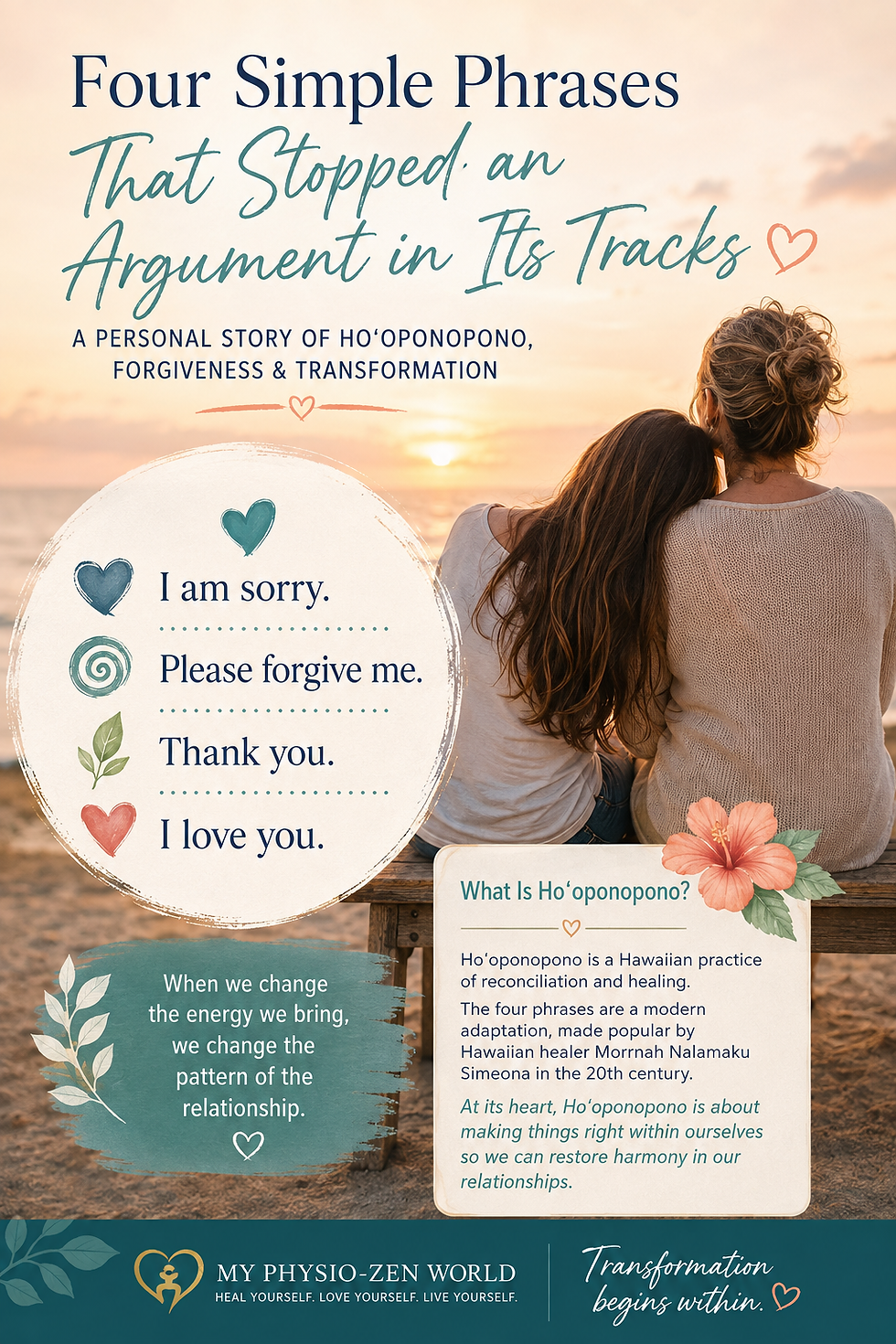
Four Simple Phrases That Stopped an Argument in Its Tracks: I’m sorry. Please forgive me. Thank you. I love you.
Recently, I was struggling with my daughter.
It was one of those mother-daughter disagreements that probably started over something relatively small but somehow became anything but small.
We were both angry. The texts were going back and forth. And after two days, I was exhausted by it.
My daughter and I love each other deeply, but we can also get caught in a pattern that I hear about from many other mothers: conflict happens, emotions escalate, and then communication can stop for an extended period of time.
Psychologists often describe prolonged intentional withdrawal of communication as the silent treatment, a form of interpersonal ostracism. It isn’t always intended as punishment—sometimes people withdraw because they are overwhelmed and need space—but when silence is repeatedly used to punish or control another person, research suggests it can be particularly painful and damaging to relationships. It threatens some of our most fundamental human needs: belonging, connection, self-esteem and a sense of control. (PubMed Central (PMC))
And perhaps that explains why these conflicts can feel so disproportionately painful.
Then I Tried Something Completely Different
For years, when I find myself caught in negative thinking, judgment, resentment or even those little gossipy thoughts that I don’t particularly like having, I have used a practice known as hoʻoponopono.
I turn toward God and repeat:
I am sorry.Please forgive me.Thank you.I love you.
For me, the words interrupt the negative thought pattern. Instead of continuing to rehearse everything that is wrong with the other person—or everything they did to me—I redirect my attention toward forgiveness, gratitude and love.
So, after two days of angry texts with my daughter, I decided to do something different.
Instead of defending myself again, explaining myself again or trying to win the argument, I texted her those four sentences:
I am sorry.Please forgive me.Thank you.I love you.
The change was immediate.
The arguing stopped.
Her tone completely changed.
She actually said something nice.
I remember thinking: Well, that worked like a charm.
What Is Hoʻoponopono?
Hoʻoponopono comes from Hawaiian culture and has a much richer history than the four sentences commonly associated with it today.
Traditional Hawaiian hoʻoponopono was a practice of reconciliation within families. When relationships became fractured, people came together to acknowledge problems, accept responsibility, seek forgiveness and restore harmony.
The now-famous four-phrase practice is a modernized form of hoʻoponopono, associated particularly with Hawaiian healer Morrnah Nalamaku Simeona, who developed a more individual, inwardly directed approach in the 20th century. So while the four phrases reflect themes of reconciliation and forgiveness, they should not be confused with the entire traditional Hawaiian practice. (All Concepts of Life)
I think that distinction matters. We can appreciate the wisdom behind a practice while also honoring where it came from.
Why Might Four Little Sentences Work So Well?
I don’t believe we need to claim that four sentences possess some scientifically proven power to magically change another person.
Something potentially more interesting is happening.
They change the person saying them.
Think about what happens during an argument. We begin building our case.
She shouldn’t have said that.
I’m right.
She needs to understand what she did.
I’m not apologizing until she does.
Our minds keep feeding the conflict.
Then imagine replacing that internal conversation with:
I’m sorry.
Defensiveness softens.
Please forgive me.
We acknowledge that we may have contributed to the conflict—even if we don’t believe we caused all of it.
Thank you.
Our attention shifts from grievance toward gratitude.
I love you.
And suddenly we remember something bigger than the argument: the relationship.
That shift can change the next text we send, the tone of our voice, our facial expression, the words we choose and our willingness to listen.
And when one person changes the emotional pattern, the other person no longer has exactly the same argument to fight against.
Someone Has to Stop the Cycle
Conflict often becomes reciprocal.
You hurt me.
I defend myself.
My defense feels like an attack to you.
You attack back.
I withdraw.
You withdraw.
And around we go.
Research on the silent treatment illustrates just how powerful these cycles can become. A recent systematic review found that prolonged communication withdrawal can involve emotional regulation, avoidance and attempts to exert interpersonal control, and that repeated use is associated with emotional distress and poorer relationship satisfaction. (PubMed Central (PMC))
But somebody has to be willing to change the pattern.
That doesn’t mean accepting mistreatment.
It doesn’t mean abandoning healthy boundaries.
It doesn’t mean admitting that everything was your fault.
And it certainly doesn’t mean that four sentences will resolve every relationship conflict.
It simply means choosing not to keep feeding the same emotional loop.
The Physio-Zen Lesson
This experience reminded me of one of the principles at the heart of My Physio-Zen World:
We cannot always control another person’s thoughts, emotions or behavior. But we can change what we bring into the interaction.
Sometimes transformation doesn’t begin by convincing the other person to change.
It begins by changing ourselves.
Hoʻoponopono gives me a remarkably simple way to do that.
The next time you find yourself replaying an argument, composing the perfect angry response in your head, judging someone or holding tightly to resentment, try stopping for a moment.
You don’t even have to say the words to the other person.
Say them quietly to yourself, to God, or as part of your own reflective practice:
I am sorry.Please forgive me.Thank you.I love you.
Then notice what happens inside you.
Maybe the first miracle isn’t that the other person changes.
Maybe it’s that you do.


Comments