
Feed Your Second Brain
How Your Gut Microbiome Shapes Your Cravings, Health, and Metabolism
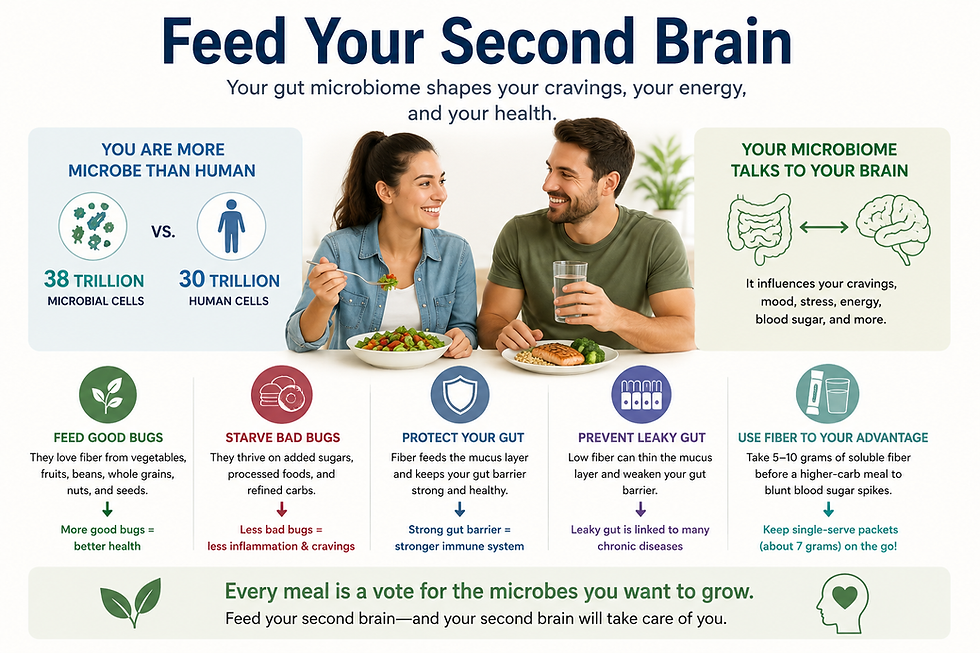
Imagine carrying around an entire ecosystem inside your body.
Not a few hundred organisms.
Not a few thousand.
Trillions.
Hidden within your digestive tract lives an enormous community of bacteria, fungi, viruses, and other microorganisms collectively known as the gut microbiome. Scientists increasingly recognize the microbiome as one of the most important regulators of human health.
Current estimates suggest the average adult carries approximately 38 trillion microbial cells compared with about 30 trillion human cells. While these numbers vary from person to person, they remind us that we are not simply human—we are an intricate partnership between our own cells and trillions of microscopic companions.
The question is:
Who are you feeding every day?
That answer may determine far more about your health than you realize.
Your Gut Is Constantly Talking to Your Brain
For decades, scientists believed the brain controlled the gut.
Today we know the communication goes both directions.
This communication system is called the gut-brain axis.
Your gut and brain are connected through several pathways:
The vagus nerve
Hormones
The immune system
Chemical messengers produced by gut microbes
Short-chain fatty acids created when bacteria digest fiber
Some researchers now refer to the gut as our “second brain.”
Although your gut does not think like your brain, it continually sends signals that influence:
Hunger
Fullness
Mood
Stress
Energy
Blood sugar regulation
Inflammation
Food cravings
This helps explain why changing the foods you eat often changes the foods you want.
Your Microbes Eat Before You Do
Every meal you consume also feeds trillions of microorganisms.
Different foods nourish different microbial communities.
Think of your microbiome like a garden.
Feed the flowers…
More flowers grow.
Feed the weeds…
More weeds appear.
The same principle applies inside your intestines.
Beneficial microbes thrive on:
Vegetables
Fruits
Beans
Lentils
Whole grains
Nuts
Seeds
Dietary fiber
These microbes produce compounds that:
Reduce inflammation
Strengthen the intestinal barrier
Improve insulin sensitivity
Help regulate appetite
Support immune function
Less desirable microbial communities flourish with diets high in:
Added sugars
Highly processed foods
Refined starches
Diets consistently low in fiber
Over time, this dietary pattern can reduce microbial diversity and favor species associated with poorer metabolic health.
The remarkable part is that the microbiome is adaptable. As your eating pattern changes, the microbial community changes with it.
Why Your Cravings Begin to Change
Many people following the Unstacking Diet notice something surprising.
The cravings that once seemed impossible to resist slowly begin disappearing.
Why?
It’s not simply because you developed stronger willpower.
It’s because your biology is changing.
Beneficial bacteria produce compounds called short-chain fatty acids, especially butyrate, acetate, and propionate, when they ferment dietary fiber.
These compounds help:
Improve blood sugar regulation
Lower inflammation
Support hormones involved in hunger and fullness
Communicate with the brain through the gut-brain axis
At the same time, stabilizing blood glucose and reducing rapid insulin swings makes the brain less likely to signal for quick sources of energy.
The result?
Less mental “food noise.”
Many people describe feeling free for the first time in years.
What Is Leaky Gut?
Your intestines are designed to be selective.
They allow nutrients into your bloodstream while keeping bacteria, toxins, and partially digested food where they belong.
This protective barrier consists of:
Intestinal cells
Tight junction proteins
A thick protective mucus layer
Immune cells
Beneficial bacteria
One important job of dietary fiber is feeding bacteria that help maintain this protective mucus layer.
When fiber intake remains chronically low, certain bacteria increasingly consume the mucus layer because it becomes one of the few remaining energy sources available to them.
Over time, this may thin the protective barrier.
Combined with inflammation and other factors, this can contribute to increased intestinal permeability, commonly called “leaky gut.”
Instead of acting as a tightly woven screen, the intestinal lining becomes more like a screen with enlarged openings.
Undesirable substances may cross into the bloodstream more easily, triggering immune activation and inflammation.
Why Does Leaky Gut Matter?
Research continues to evolve, but increased intestinal permeability has been associated with:
Obesity
Type 2 diabetes
Metabolic syndrome
Non-alcoholic fatty liver disease
Inflammatory bowel disease
Certain autoimmune diseases
Cardiovascular disease
Depression and anxiety
Scientists are still determining whether increased permeability is a cause, a consequence, or both in many of these conditions.
What is becoming increasingly clear is that maintaining a healthy intestinal barrier supports overall health.

Fiber: The Forgotten Superfood
When people think about nutrition, they often focus on protein.
Or carbohydrates.
Or fats.
Fiber rarely gets much attention.
Yet fiber may be one of the most powerful nutrients for improving metabolic health.
Unlike many carbohydrates, humans cannot digest fiber.
Instead…
Your microbes digest it.
Fiber becomes food for the beneficial bacteria living in your colon.
This process produces short-chain fatty acids that:
Nourish the cells lining your colon
Reduce inflammation
Improve insulin sensitivity
Strengthen the gut barrier
Help regulate blood sugar
Support immune health
Increase feelings of fullness
In many ways, fiber feeds the tiny partners that help keep you healthy.
Most of Us Aren’t Getting Enough
The average American consumes only 15–17 grams of fiber per day.
Current recommendations are:
Women: approximately 25 grams per day
Men: approximately 38 grams per day
Many experts in gut health recommend aiming for 30 grams or more daily from a wide variety of plant foods to encourage a diverse microbiome.
Increasing fiber gradually while drinking adequate water can help reduce temporary bloating as your microbiome adapts.
Can Fiber Help During a Higher-Carbohydrate Meal?
One of my favorite practical strategies is using soluble fiber before meals.
Research has shown that consuming approximately 5–10 grams of soluble fiber, such as psyllium husk, shortly before or with a meal may:
Slow stomach emptying
Reduce blood sugar spikes
Lower insulin responses
Increase fullness
Feed beneficial gut bacteria
The Unstacking Travel Tip
Carry single-serving packets containing approximately 7 grams of soluble fiber in your purse, briefcase, backpack, or car.
If you know you’re about to enjoy a higher-carbohydrate meal, mix one packet into a glass of water shortly before eating.
Think of it as adding another layer of protection for your metabolism.
This is not permission to regularly overeat processed foods.
Rather, it is a simple strategy that may help lessen the metabolic impact of an occasional higher-carbohydrate meal while simultaneously nourishing your microbiome.
The Unstacking Philosophy
Every meal does more than feed you.
It feeds trillions of organisms living inside you.
Every bite is a vote.
A vote for inflammation…
or healing.
A vote for cravings…
or freedom.
A vote for instability…
or metabolic health.
One of the greatest gifts of the Unstacking Diet is that it doesn’t simply change what you eat.
Over time, it changes the microscopic community that influences what you want to eat.
As beneficial microbes become more abundant, many people naturally begin craving fresh foods, vegetables, fruit, legumes, and other fiber-rich meals.
The battle with food becomes quieter.
Health no longer depends entirely on willpower.
Instead, your microbiome begins working with you rather than against you.
When you feed your second brain, your second brain starts taking care of you.
Key Takeaways
✓ Your gut contains approximately 38 trillion microbial cells, compared with about 30 trillion human cells.
✓ Your microbiome communicates constantly with your brain through the gut-brain axis.
✓ Diets rich in fiber support beneficial microbes that promote metabolic health.
✓ Diets high in ultra-processed foods and low in fiber can reduce microbial diversity and contribute to poorer metabolic health.
✓ Dietary fiber helps beneficial bacteria produce compounds that strengthen the intestinal barrier, improve insulin sensitivity, and reduce inflammation.
✓ Most adults consume far less fiber than recommended.
✓ Soluble fiber taken before meals may help reduce post-meal blood sugar spikes while supporting a healthier microbiome.
✓ Every meal feeds both you and the trillions of microbes that live within you.
Selected References (2021–2025)
Fan Y, Pedersen O. Gut microbiota in human metabolic health and disease. Nature Reviews Gastroenterology & Hepatology. 2025.
Nature Reviews Microbiology. The gut microbiome and metabolic disease. 2024–2025 review series.
American Society for Nutrition. Dietary Fiber and Cardiometabolic Health. 2023.
American Diabetes Association. Standards of Care in Diabetes. 2025.
Sonnenburg ED, Sonnenburg JL. Research on dietary fiber, microbiome diversity, and intestinal mucus barrier.
USDA Dietary Guidelines for Americans, 2020–2025 (current recommendations for fiber intake).
Institute of Medicine/National Academies. Dietary Reference Intakes for Fiber.


Comments